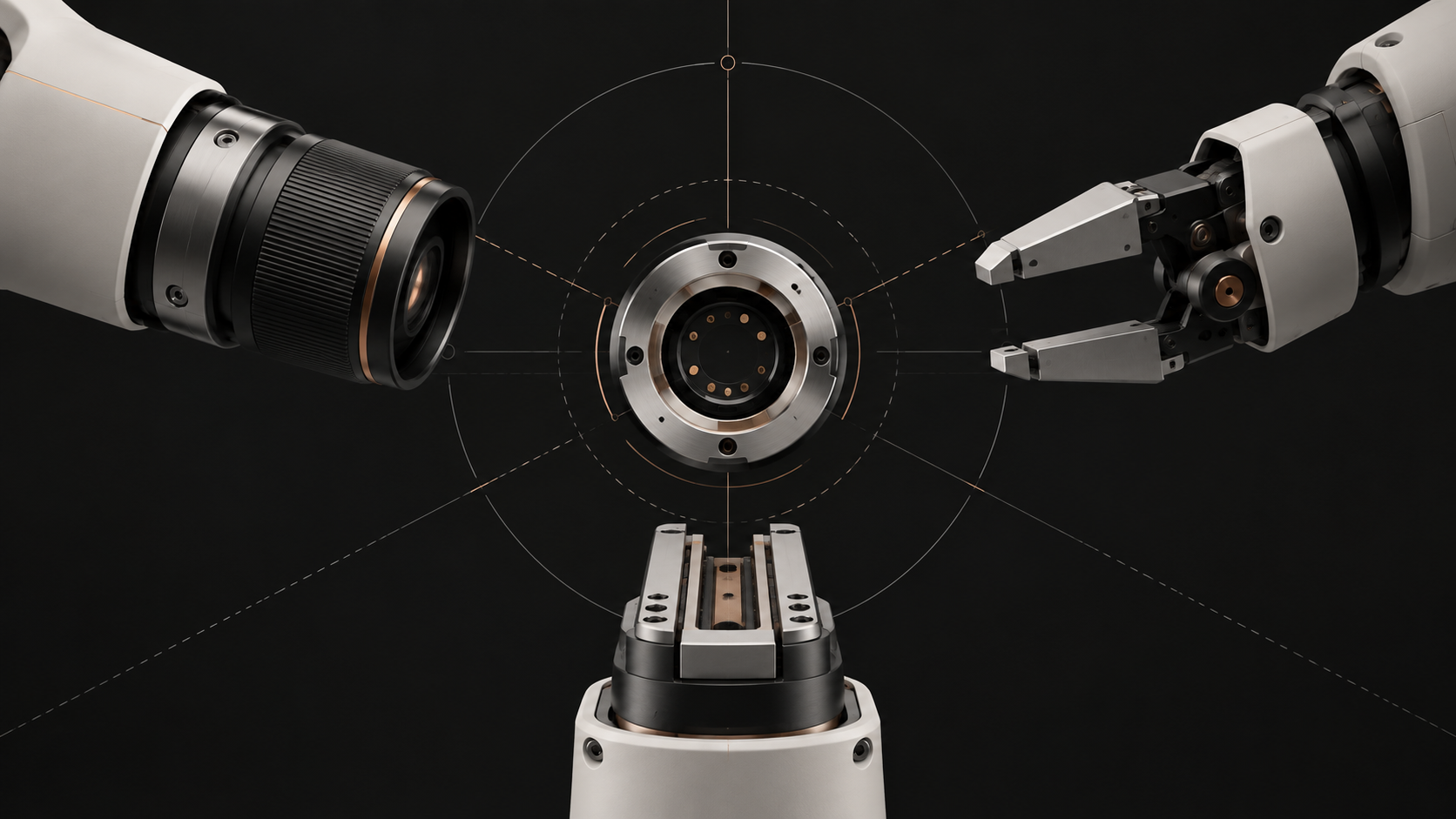
Getting an agent to write a test script is one thing. Running it on a bench, checking the measurements and using the result to improve a design is another.
01What Anthropic announced
On 27 August 2026, Anthropic introduced the Model Hardware Standard: a common interface intended to help agents discover and operate physical equipment. Its drivers expose read/write operations and descriptions of device capabilities, characteristics and limits. Agents can reach them through MCP, command-line tools or APIs. Anthropic also describes turning sequences into deterministic code, rather than requiring model reasoning for every operation. Anthropic’s announcement
Agents could already operate hardware through custom integrations. MHS is interesting because it aims to make that connection reusable across devices and teams. For an engineering lab, that could mean less time connecting instruments and more time finding out why a prototype failed.
02What MCP taught us
MCP arrived in November 2024 with a specification, SDKs, reference servers and support in Claude Desktop. Developers could try an integration without first inventing its entire communication layer. MCP launch
By December 2025, MCP maintainers reported 97 million monthly SDK downloads, 10,000 active servers and support across major AI applications. Those are historical ecosystem figures, not current user counts. Maintainers’ update
MCP also became a founding project of the Agentic AI Foundation under the Linux Foundation. Foundation announcement
Our reading is that usefulness and shared ownership reinforced each other. A connector became more valuable when several applications could use it; an application became more useful as compatible connectors accumulated. That is a plausible explanation for momentum, not a controlled study of its causes. Hardware could benefit from a similar pattern, but it has not earned the same conclusion yet.
03From context to physical action
MCP supplies a client-server protocol through which applications discover and use tools, resources and prompts. It does not determine how an application reasons. MCP architecture
MHS is therefore complementary, not a replacement. MCP can already carry calls to hardware-facing tools; it is not confined to software. MHS addresses how the equipment behind those tools is described and operated. A useful conceptual stack is an agent reaching an MHS driver through MCP, a CLI or an API, with observations returning from the device. This is an explanatory sketch, not a complete implementation specification. MHS overview
Strands is already exploring that connection: its team describes native MHS support as a pre-release mesh backend for preview participants. AWS subsequently confirmed its participation in the limited preview. Neither announcement means that MHS support is generally available. Strands’ account, AWS recap
The practical question is whether changing one instrument could eventually require a different driver, rather than rewriting the surrounding experiment.
Conceptual architecture; not a safety boundary.
04The opportunity for builders
For makers, the valuable outcome would be a shorter path from an idea to a repeatable experiment. Imagine a small team combining a camera, a positioning stage and a measurement instrument. Today’s working prototype may depend on one person remembering which script, configuration and timing assumption belongs to each component.
A shared interface could make those assumptions easier to describe, inspect and transfer. Another builder might reuse the integration while changing the experiment. A documentation page could travel with a test fixture instead of remaining detached from the system it explains.
That suggests a community opportunity beyond writing drivers. Builders could contribute simulators, test cases, failure records and compatibility notes. Each contribution would make the next integration easier to assess.
This is our thesis, not a report of an established MHS ecosystem. Reuse only helps when the shared component is trustworthy, maintained and clear about its limits. A growing driver directory alone would not demonstrate that.
Make the integration reusable.
Make the result reproducible.
05Where engineering AI meets the test bench
Writing a test script is only part of the job. Someone still has to connect it to the right equipment, establish the starting conditions, capture the measurements and decide what a failure means. This is where we see a useful bridge between AI-assisted engineering and systems that act in the physical world.
Consider three supervised workflows we would like to explore. These are possible applications, not turnkey MHS features or deployments Anthropic has announced.
Hardware-in-the-loop testing. A real electronic control unit, or ECU, runs against a simulated vehicle or machine. With suitable drivers and approved procedures, an agent could prepare the bench configuration, flash an approved firmware build, run a test sequence and compare the signals with the previous run. When something fails, it could gather the relevant traces and propose the next test. The useful output is not just “test failed”, but a reproducible case that helps an engineer narrow down the cause.
Physical component testing. Think of a component tested under changing loads or temperatures. An agent could coordinate a test rig, sensors and an environmental chamber within an approved test plan, collect measurements and compare them with the requirement being tested. The record would need to retain the component revision, fixture, calibration, units and actual conditions. Otherwise, a convincing comparison could be built from measurements that were never comparable.
Mechatronic system validation. A robot, camera and measurement instrument may each report success while the assembled system still misses its target. An agent could coordinate a repeatable experiment, align the observations and help investigate whether a problem follows a vision estimate, an actuator response or an integration change. A parameter adjustment would then become a testable proposal, followed by another measured run—not an unexplained tweak that happens to make the demo work.
In each case, the agent's role is to organize and interpret the experiment. Timing-critical control and protective interlocks belong in the controller and test system, not in a language model's response loop. MHS could make that division easier to connect; it does not remove it.
06Close the loop, not just the test report
The larger opportunity is what happens after the measurement. A result can sit in a report, or it can change the next engineering decision.
Design → Simulation → Physical Test → Learn → Redesign
Suppose a prototype responds more slowly on the bench than it did in simulation. An agent could bring together the test trace, the relevant simulation assumptions and the original requirement. It might suggest a new experiment to distinguish a mechanical limitation from a control issue, then draft a change for the team to review. That change could affect a parameter, a component choice, the system architecture or an assumption in the requirement itself. A requirement should not be relaxed merely to make a failed test pass.
For that loop to be useful, every handoff needs a record: which design and firmware were tested, under what conditions, against which acceptance criteria, and what changed before the next run. MHS could help connect the devices, while engineering tools and their integrations carry the evidence back into the design process. Neither connection alone establishes that the conclusion is correct.
This is the convergence we care about. AI-assisted engineering helps a team reason about what to build; physical testing gives that reasoning something to answer to. If less effort goes into moving files and reconstructing context, teams could spend more of each iteration resolving the uncertainty that matters. Shorter development and industrialization cycles are a potential result to measure, not a benefit we can assume from adopting an interface.
07A standard is not a safety case
Reading a value and changing the physical world are different responsibilities. An acknowledged command does not prove an intended action happened. A delayed observation may describe a machine that has already moved. Recovery can introduce another change rather than restore the previous state.
Anthropic itself notes limitations in models’ physical reasoning and the continuing need for expert oversight. Research-preview limits
For us, a dependable system would need an explicit separation between what an agent may request, what software permits and what the equipment can physically enforce. Its evidence should include unsuccessful runs, interruptions and human interventions—not only a polished demonstration.
We would judge interoperability and operational safety separately. Passing an interface test should not be presented as permission to leave equipment unattended, or as a substitute for a qualified assessment of the complete installation.
08What we would test at Armature
We would begin with a narrowly scoped, supervised evaluation—not a claim that an autonomous lab is ready. The following is a proposed research agenda; it does not imply that Armature has MHS access, a partnership or an existing deployment.
Can another builder reproduce the integration? We would record the device configuration, driver revision, dependencies and assumptions, then ask whether a second person can understand the same setup without its original author.
Does the interface describe reality? We would examine whether reported state, units, completion signals and unavailable capabilities remain unambiguous. We would want discrepancies recorded, rather than smoothed into a success message.
Can failure be understood? We would evaluate how the system reports interruptions, rejects unsupported requests and distinguishes a proposed recovery from an authorized action. The evidence must show where human judgment remains necessary.
Does the result reach the next design decision? We would follow one finding from a recorded test back to its requirement, through a reviewed change and into a repeat run. Producing a report is not enough if the next builder cannot tell what was learned or why the design changed.
Is reuse actually cheaper? We would compare integration effort, maintenance work and reproducibility across a small set of configurations. A shorter first demo is useful; a second team’s successful repeat would be more persuasive.
09The next interface layer
MCP made it easier for a useful software integration to reach many applications. We think MHS could give builders a similar starting point at the bench: shared device interfaces on which they can build, inspect and repeat experiments.
MHS is a credible direction to investigate, not a guaranteed winner. Its eventual importance will depend on public specifications, usable implementations, cross-vendor participation and evidence that survives outside the original demonstrations.
For Armature, the compelling outcome is an engineer moving from a failed prototype to a better-informed next version, with the evidence still attached. Bringing engineering AI and physical AI together should make that path shorter and easier to follow. We would judge progress by whether the next team can repeat the experiment and understand the decision—not by how autonomous the demonstration looks.
References
- Anthropic — Previewing the Model Hardware Standard
- Model Hardware Standard — Official research-preview site
- Strands — Robots working together with MHS
- AWS — What landed for AI builders in August 2026
- Anthropic — Introducing the Model Context Protocol
- MCP — Architecture overview
- MCP — Joining the Agentic AI Foundation
- Linux Foundation — Formation of the Agentic AI Foundation