Reproduce
Re-run released analysis and turn the literature into a versioned, inspectable lab record.
Armature AI Labs' replication track for millimeter-scale artificial muscles that combine an embedded electrohydrodynamic pump with thin fluidic actuators. The first goal is an instrumented bench coupon, not a wearable demo.
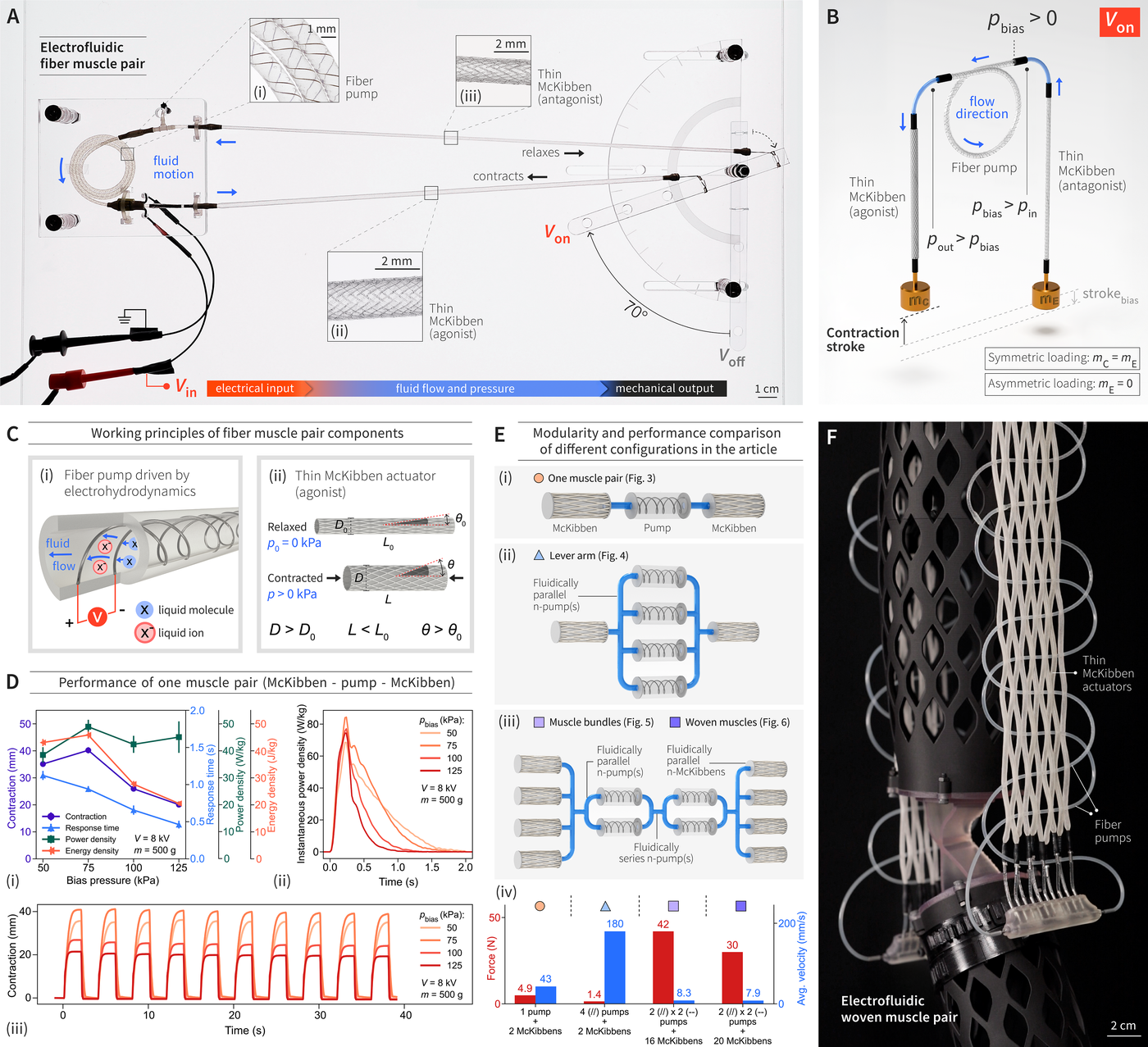
The pump becomes part of the muscle fiber, removing the external hydraulic pump and fluid tubes while retaining an electrical tether.
An electric field drives dielectric fluid through a helical electrohydrodynamic pump between two thin McKibben actuators. As one contracts, the opposing actuator receives fluid and stores the return volume. A controlled initial pressure is central to avoiding cavitation and electrical failure.
The supplied Science DOI is the 2023 foundational fiber-pump paper. The electrofluidic muscle itself was published in Science Robotics in 2026 under DOI 10.1126/scirobotics.ady6438. Both remain in the research record because they answer different parts of the build.

Reproduce the mechanism in evidence-producing stages, then determine whether it is reliable enough for a robot joint or textile structure.
Re-run released analysis and turn the literature into a versioned, inspectable lab record.
Measure pump, actuator, and closed-loop behavior independently before integrating a demonstration.
Study winding repeatability, sealing, bias pressure, efficiency, thermal limits, and cycle life.
The open precursor manuscript specifies a 200 mm pump coupon built around a 1.2 mm mandrel, six TPU filaments, and two continuous 80 micrometre copper-wire electrodes. That is enough to establish winding, fusion, sealing, and metrology before the lab attempts a closed-loop muscle.
This baseline reproduces the fiber pump only. It does not fill in the still-unpublished actuator materials, demonstration lengths, working-fluid volume, bias pressure, sealing procedure, drive limits, or lifetime distribution of the 2026 system.
Every stage ends with evidence and a stop/go review. Later stages do not begin because an earlier specimen moved once.
Run the released analysis, reconcile the paper, preprint, dataset, and media, then freeze a versioned research brief.
Exit evidence: Reproducible notebook, source register, preliminary BOM, hazard reviewCreate a dry, unenergized winding and inspection workflow before introducing working fluid or electrical power.
Exit evidence: Fixture CAD, measured geometry, microscopy record, repeatable samplesCharacterize the thin McKibben actuator separately with a conventional regulated pressure source.
Exit evidence: Pressure, contraction, force, leakage, and cycle dataEnergize only inside an interlocked, current-limited high-voltage cell and map pressure, flow, current, and temperature.
Exit evidence: Signed SOP, isolation test, pump curve, failure logJoin two actuators and the embedded pump, then determine the bias-pressure window that avoids cavitation and instability.
Exit evidence: Sealed loop, bias map, closed-loop force and stroke dataMove a guarded lever or test mass before considering a bundle, robot joint, woven structure, or wearable form.
Exit evidence: Repeatability, efficiency, thermal behavior, cycle life, teardown reportKeep electrical input, fluid transport, mechanical output, and measurement visible as separate subsystems.
Controlled electrical input
Electric field moves fluid
Sealed flow and bias pressure
One contracts as one receives fluid
Force, stroke, current, heat
This project combines kilovolt-class electrical work, pressurized fluid, custom materials, and stored mechanical energy. It belongs in a controlled research cell.
Energize only inside an interlocked, guarded, current-limited high-voltage enclosure with a verified discharge state.
Approve the dielectric fluid from its current SDS, compatibility data, spill plan, storage requirements, and disposal route.
Use pressure-rated fittings, shielding, leak inspection, remote instrumentation, and defined pressure limits.
Do not substitute the working fluid without dielectric, vapor-pressure, EHD, and material-compatibility validation.
Do not scale to a parallel bundle until three independent pump coupons reproduce reliably.
No human-contact, wearable, overhead-lifting, or autonomous energization work in the initial replication stages.
The project is published with strong scientific evidence and released data, but not as a turnkey fabrication kit. Armature AI Labs' contribution is a traceable path from source to repeatable bench result.
SOP · versioned BOM · fixture CAD · analysis notebooks · test data · failure register · build logs